
Acoustic Simulations and Barriers
Advanced modeling and mitigation solutions for environmental noise control
Advanced modeling and mitigation solutions for environmental noise control
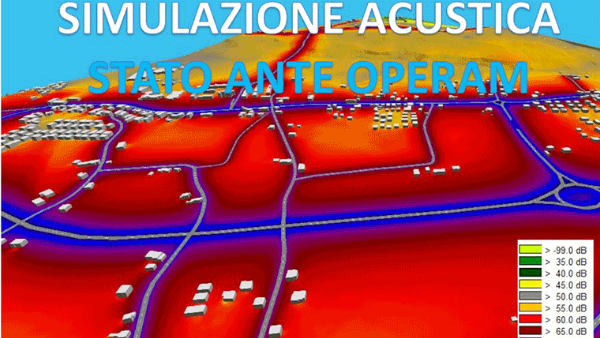
Predictive assessment for sustainable projects
. Predictive acoustic simulation allows for knowing and evaluating the sound level induced during or after the completion of a project. Complex analysis that determines in advance the measures to be applied to projects to comply with industry standards. The models are calibrated with field sound level measurements for maximum precision (Ref. MIT Environment).
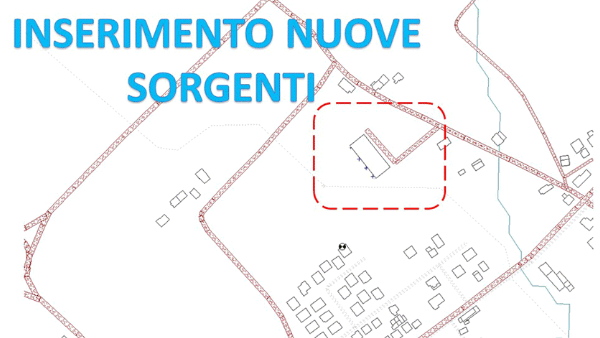
Complete modeling with multiple results
. The software provides horizontal maps, vertical sections of isophonic curves, and summary tables of point sound pressure levels. We model new linear infrastructure (roads, railways, construction sites), commercial and industrial activities, and airports. The models achieve substantial agreement with post-construction experimental data.
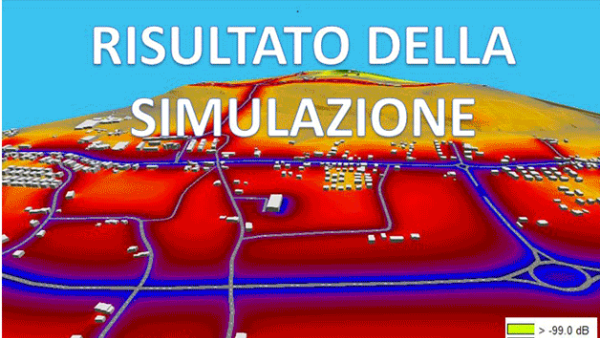
Post-construction validation with advanced software
. Processing of acoustic simulations mapped through predictive software that simulates complex environments with numerous types of acoustic sources. The models are validated by substantial agreement with experimental data measured after the completion of the project, ensuring scientific reliability.
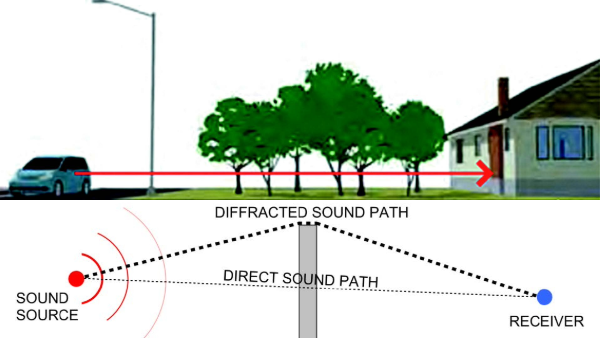
Control of sound propagation.
Sound reaches a receiver directly (straight line) or indirectly through reflection or diffraction, causing "bending" around corners. Noise barriers or embankments interrupt the direct path, significantly reducing sound levels at sensitive receptors.
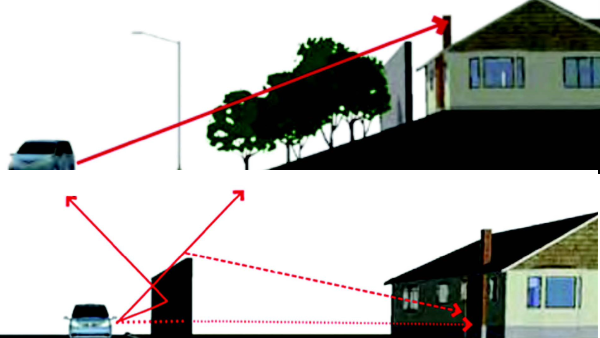
Optimal sizing for maximum effectiveness.
By introducing a barrier between the source and the receiver, the amount of sound reaching the receptor is significantly reduced. Height is a fundamental parameter: greater height, greater reduction. The barrier must block the line of sight from the dwelling to the vehicle engines; even lower barriers can significantly reduce noise.
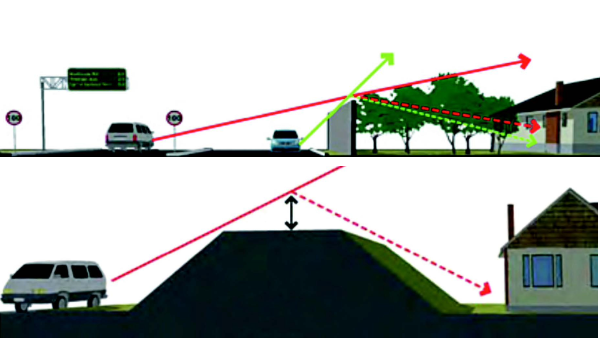
Landscape-integrated solutions
. For multi-lane roads, noise from distant lanes is not reduced as much as that from nearby lanes due to different propagation angles. Where space allows, embankments represent more attractive solutions, either alone or with planting, or combined with low wall barriers on top of the earth embankment.